

Ep608 - Head Lice
Why Jemmy's Haircut Won't Cut It

NOTE: These discussions presume you have seen the episode listed above. If you haven’t seen this episode, be forewarned: there be spoilers here!
In episode 608, Roger, Brianna, and Jemmy are bumping along in their wagon on the road to Edenton where Roger plans to attend the Presbyterian seminary to become ordained as a minister.

Credit: Outlander Ep608 - I Am Not Alone. Bree and Roger travel to Edmonton with Jemmy in the back of the wagon.
Bree and Roger are remarking on the fact that in their time (in the future) this trip would take them but an afternoon’s drive, and now it’s weeks of wagon travel and camping under the stars.
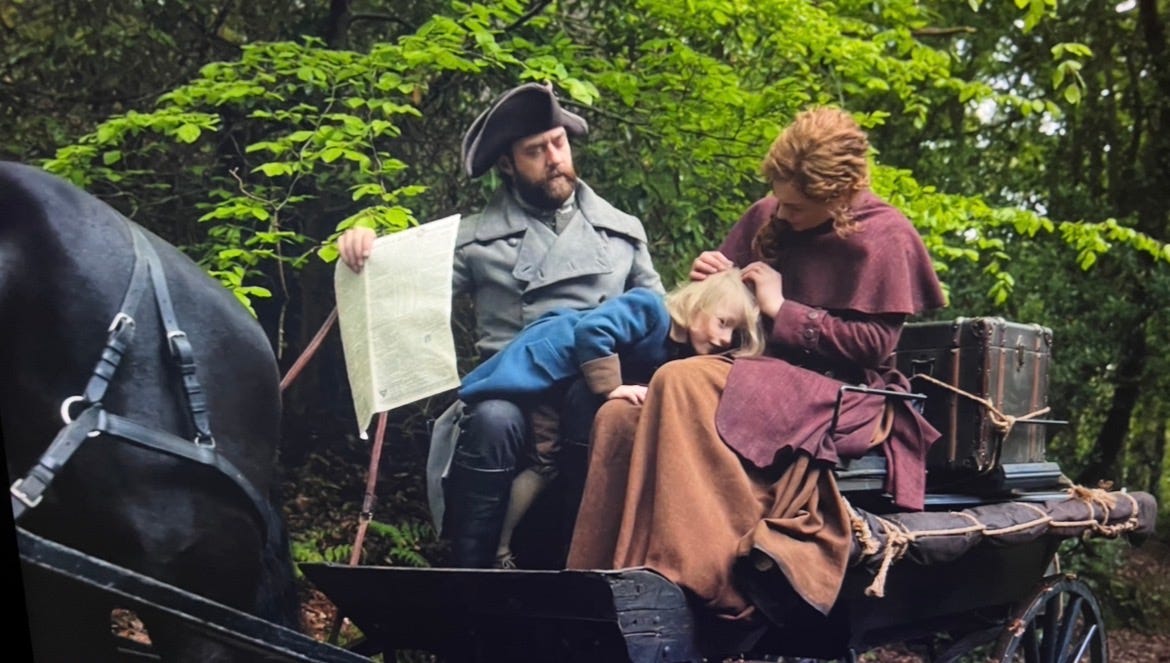
Credit: STARZ Outlander Ep608 - I Am Not Alone. Bree looks through Jem’s hair and scalp.
Bree notices Jemmy scratching at his head and asks him if it’s itchy, to which he nods that it is. She pulls him up into her lap and searches through his pretty long blonde hair, discovering, to her dismay, that he has lice. ‘Where did he get lice?’ she asks Roger. Who doesn’t seem surprised because, he tells her, some of the boys up at the Fisherfolk camp that Jemmy plays with have recently turned up with lice. And she says to Jemmy, ‘Looks like you’ve got ‘em, too. We’re gonna have to cut your hair.’
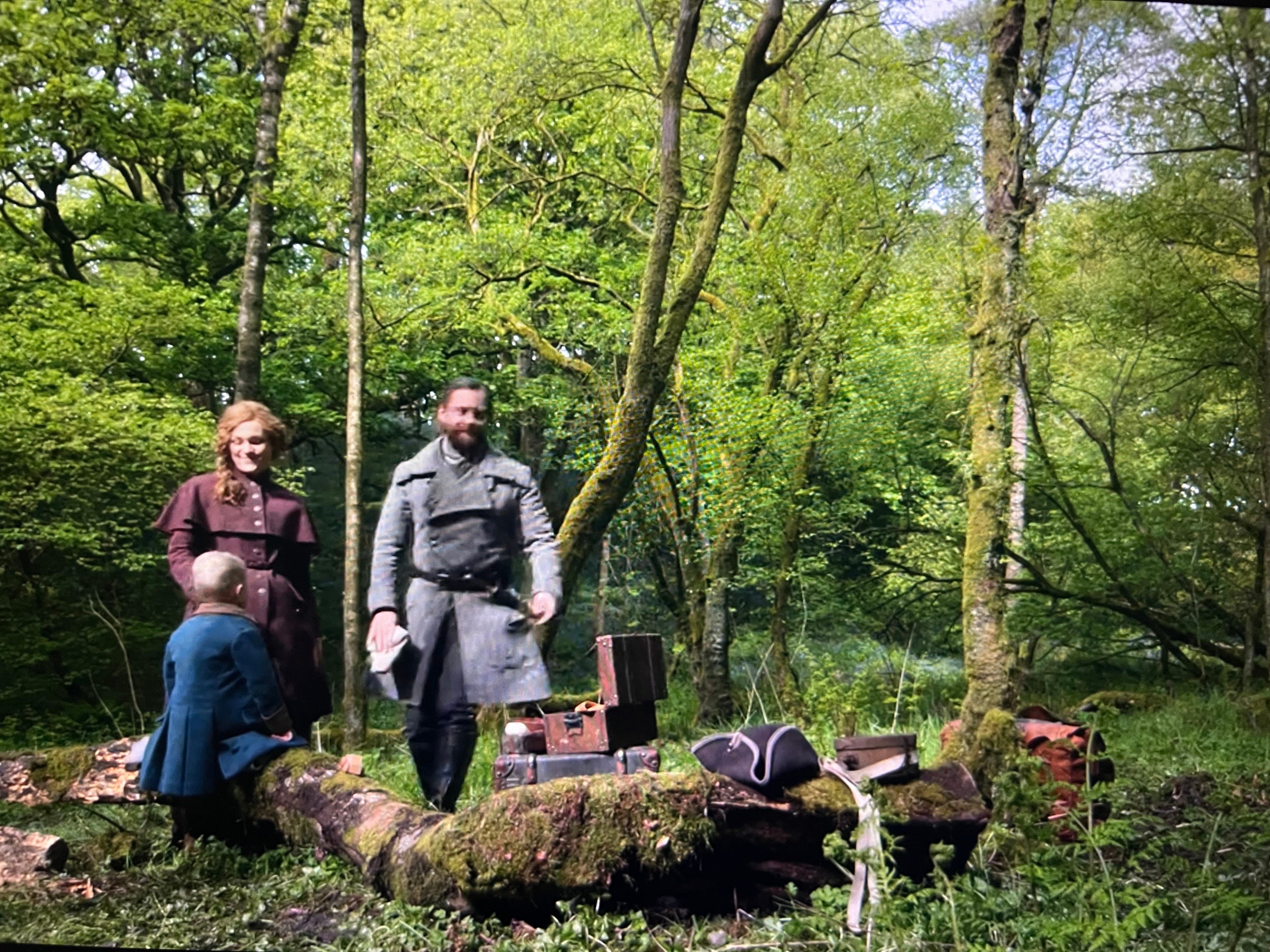
Credit: STARZ Outlander Ep608 - I Am Not Alone. Bree and Rogers stand back to admire Jemmy’s new short hair.
Fortunately, Roger has brought along his barbering kit, so they pull off the road to immediately cut Jem’s hair quite short with a large pair of shears.
In a charming little interchange that follows, Bree discovers a small growth (a mole) on Jem’s scalp and is concerned. Roger takes a look and assures her that it’s nothing. ‘Just a nevus,’ he says (correct in that). ‘They’re harmless.’ Then when she notes he wasn’t born with it, Roger adds, ‘They don’t usually show up until you’re two or three years old.’ Then he shows her he has one, himself, in almost the precise location, adding, ‘They’re hereditary.’ And with knowing smiles, they both realize the genetic implications of such a thing. Roger is his.
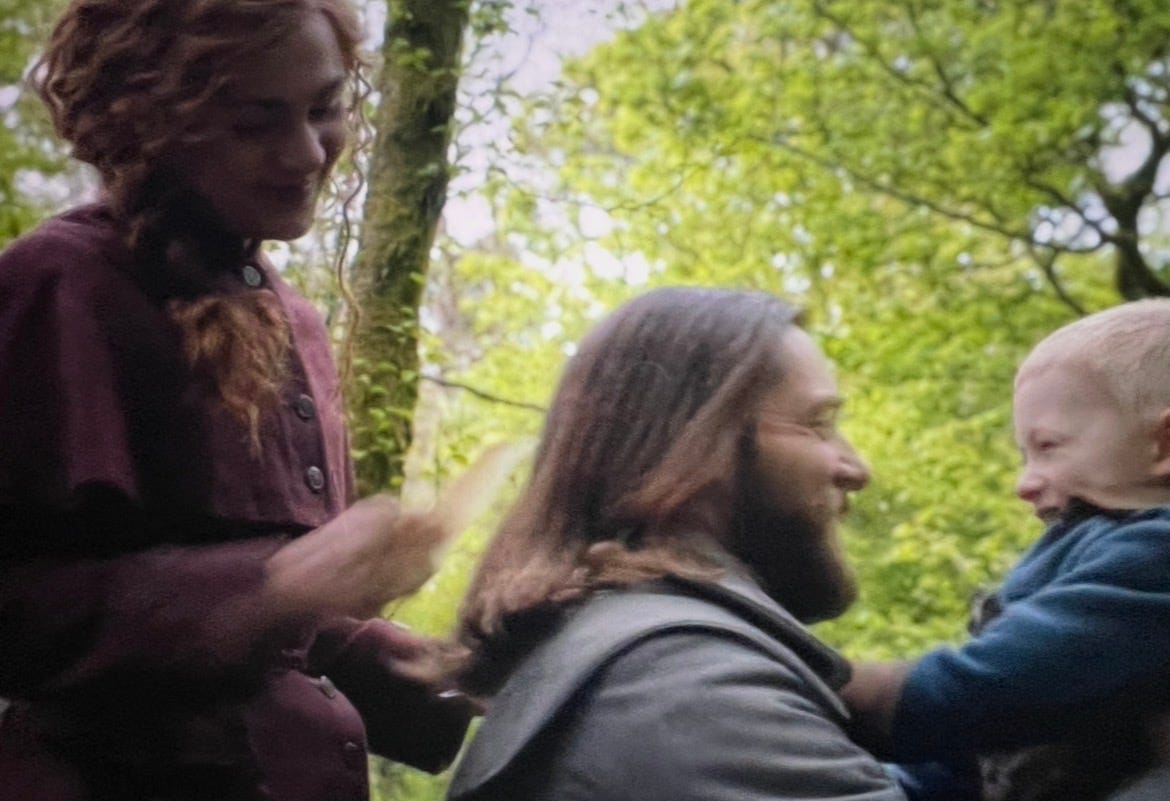
Credit: STARZ Outlander - I Am Not Alone. Roger claims he too may have picked up a few lice and sits to let Bree cut his hair in solidarity.
So Roger decides to cut his hair, too, just for good measure, for moral support, or perhaps to let his own hereditary nevus show. ‘Like father, like son.’
And there that storyline ends.
But in truth it would be just the beginning. Because the lice and their nits would be in their pillows and their bedding and their clothing as well and a haircut isn’t going to fix that. Because…
The 18th Century was Lousy
Head lice appear to have been uncommonly plentiful in 18th colonial America (and almost everywhere else and for many centuries before that). Essentially everyone experienced having them; it was a routine nuisance across all classes. Studies of the records of early North American forts and settlements describe lice as “routine companions” of people of all socioeconomic levels well into the 18th and early 19th centuries.
Overcrowding, infrequent bathing, and repeated wearing of the same clothing and use of the same bed linens, conditions that favor passing lice from person to person, are well documented in the American colonial and early Revolutionary period.
Genetic work on human lice – yes, it’s odd I know but people do study such things – indicates these parasites arrived in the Americas with both ancient and later human migrations, so by the colonial period they were long‑established fellow travelers of humans in the New World.
So the world was lousy, so to speak, and people had to deal with them as best they could.
The Louse Families
Brianna is correct that Jemmy has head lice, in scientific terms, Pediculus humanus capitis. And by and large that’s where these lice will stay – on his head. They won’t stray from their preferred habitat to other parts of the body. Fortunately, unlike some of their lousy cousins, they’re not common vectors of serious diseases, though they like other arthropods can (though very rarely) transmit a few of them.


Credit: WikiCommons media. Left - the human louse nit attached to a hair. Right - the adult human louse (a head louse).
The lice that affect most of the rest of the body, body lice, Pediculus humanus corporis are a different subspecies of the same louse family, but they’re what are called ectoparasites; they make their home not on the body but in the seams of clothing and in bedding and only come out to wander on the body in search of food – i.e., the host’s blood.
Though the two subspecies share 99.9% of their DNA in common and could interbreed in theory, in practice they don’t. Or even share the same human habitat. The body louse, however, is much more troublesome, as it commonly acts as a vector to pass such deadly diseases as typhus, trench fever, and relapsing fever to its human host. Thus one of the major health dangers of close communal living — shipboard, prison, army camp — is body lice transmitting diseases that will kill many.
And then there are the lice one might pick up in a brothel – pubic or crab lice, Pthirus pubis – a completely different species altogether, entirely unrelated to the other two. This one makes its home in coarse hair, such as pubic hair, arm pit hair, and eyelashes. It is usually transmitted by close physical/pubic contact – i.e., sexually. They’re a blazing nuisance to the afflicted, but they don’t transmit deadly diseases.
So Jemmy’s head lice aren’t much of a serious health risk, but they are certainly an itchy pain in the keister to be infested with and an even bigger one to try to rid yourself of in the 18th Century back country. Nowadays, of course, there are pediculicides (insecticidal lotions and shampoos) that will kill adult lice and their nits (eggs). But even with modern insecticidal treatment, meticulous hot washing of bedding, pillows, clothing, combs, and brushes is still the only way to wipe an infestation out entirely.
What could someone have done at Fraser’s Ridge (or pretty much anywhere from Savannah to Wilmington to Philadelphia to New York) to get rid of them?
Typical treatments in the 18th century
Colonial practices drew on long‑standing European remedies, some mechanical, some thermal, and some chemical. Common approaches included shaving the head and wearing wigs. Men commonly shaved their heads to the scalp and wore perukes (powdered wigs); we see these styled wigs often in the series. Usually not for Jamie, or Roger, or William, or Lord John, but in the majority of others. Shaving removes the natural hair that is the habitat for the head louse.
Heat was (and is) the enemy of a louse, which meant that wigs could also be boiled periodically to kill lice and nits and then restyled. And clothing and textiles (bedding, etc.) could be boiled or otherwise heated to kill the pests.
Double‑sided bone or reed combs with very fine teeth were used specifically to strip lice and their tightly-clinging nits (eggs) from hair, just as they are today. Such combs have been archaeologically discovered and documented in early American military sites and elsewhere, so we know these were in use.
There were also topical ointments compounded of sulfur and lard that could be smeared on the scalp. Sulfur itself has some antimicrobial and insecticidal activity, and in the occlusive, greasy preparation with the lard would suffocate the lice.
An acidic astringent wash (vinegar) could be used on the hair and scalp to help dislodge the lice and does have some modest toxicity to them, but it wouldn’t be enough on its own to do much lasting good. Especially absent shaving the hair.
Powders of mercuric oxide (also called red precipitate) sprinkled on the scalp are genuinely toxic to the lice, and have been used since the Renaissance to combat lice infestation, but the downside is that if used to often or in too great a quantity, the mercury accumulates in the body and is toxic to the host as well. Hair samples from a 15th Century king show high levels of mercury, which has been interpreted as likely the result of frequent de-lousing treatments.
For poorer or rural colonists without access to fancy wigs and the staff to boil and style them or expensive mercury compounds, the mainstays would likely have been mechanical nit‑picking with fine combs, shaving or close‑cropping the hair, laundering or heating bedding and clothing when possible, and application of simple topical agents like vinegar, fats, or sulfur‑based ointments.
For those who could actually maintain this sort of regimen, it was probably quite effective at temporarily clearing infestation, though re-infestation from close contacts and bedding would remain problematic. Overall, treatments that would have been available at the time of Ep608 in colonial North Carolina could meaningfully decrease lice burden in a given individual, especially when shaving, boiling, and fine combing were combined, but they lacked safe, highly-reliable ovicidal (egg/nit killing) agents and had little understanding of the full life cycle of the louse. In dense households, plantations, and ships, head lice would have been effectively endemic despite these measures.
All to say, Bree had a lot of work ahead of her beyond giving Jemmy a cute new haircut.
All their bedding and clothing would need to be boiled or heated to kill the nits and nymphs surely harboring there. And what a monumental job that would have been with no laundromats with coin-op heavy duty washers and dryers to help out. (No one wants to wash bedding full of head lice nits in their own washer after all!) It would have been a misery to do, as we’ve seen laundry day on the Ridge — hauling water, building a fire, boiling cauldrons of hot water with lye soap and stirring the laundry with wooden paddles. Rubbing each one on a rub board. Hanging them to dry, which would have taken several sunny days with clear skies. But to do less would invite re-infestation before you could say Fraser’s Ridge.
Overall Medical Verity Score: I will give this one a B minus. I give them props for at least addressing what would have been a near-universal problem at the time and place. Everybody would have been at risk of getting lice, and it would be hard to rid a household of them once established without diligent, ongoing vigilance. And a whole lot of heavy, physical work.
To suggest that a simple haircut would do it desperately downplays the burden of dealing with something like head lice then. (Let alone if it were body lice, which would be even more problematic and could even be dangerous. I do recall seeing a deleted scene or two, one at Prestonpans I believe and one on the Ridge that dealt with body lice and how everybody had them, but I guess the Outlander EPs or STARZ decided they could let sleeping lice lie.) So I suppose my wish is that if they were going to tackle the issue they’d at least have made a bow to how difficult it was going to be to deal with it.
I suppose it was considered just part of life. Dogs get fleas, people get lice. Itchy times, indeed!